
In this guide
Follow one bottle from filling to closing. Who positions it, who places the cap, and who takes the finished bottle away? Those steps are a useful starting point for choosing a capper.
If an operator will load the bottle and place the cap, with the machine doing the tightening, consider a semi-automatic station. If bottles already move along a conveyor and you want to automate cap placement too, look at cap sorting and delivery alongside the tightening mechanism.
For semi-automatic capping: check whether the operator can keep up with the required output while loading, placing caps and removing bottles.
For automatic capping: check whether bottles and caps feed smoothly, and whether the filler and labeler can work at the same pace.
One detail is easy to miss in a quote: automatic tightening does not necessarily include automatic cap placement. Ask how each step works and which equipment is included. That will also tell you where an operator is still needed.
What changes when you automate?
| Consideration | Semi-automatic station | Automatic setup |
|---|---|---|
| Bottle and cap handling | A typical benchtop station relies on an operator to position the bottle and cap before starting the cycle. | Conveyor handling works with a compatible cap sorting, delivery and application system. |
| Production pace | Includes the tightening cycle, manual loading and removal, replenishment and checks. | Assess infeed, cap supply, tightening, discharge and the pace of adjacent equipment. |
| Changeovers | Check the capping head, bottle support, height adjustments and actual changeover time. | Also check adjustments to cap handling, guides and conveyor-related components. |
| Site requirements | Confirm the work surface, operator space and electrical and air requirements. | Confirm the complete footprint, conveyor height, maintenance access and utilities. |
| Cost comparison | Include staffing, tooling, changeovers and maintenance. | Include the capper, cap delivery, conveyors, setup and ongoing maintenance. |
Follow the bottle through each step
Semi-automatic
- Operator positions bottle
- Operator places cap
- Machine tightens cap
- Operator removes and checks bottle
Automatic
- Conveyor brings bottle in
- System sorts and delivers cap
- Matched mechanism applies and tightens cap
- Conveyor carries bottle out
The automatic sequence above includes cap sorting and delivery. Ask whether those units are included in the quote or need to be supplied separately.
The cap shape matters
“Suitable for screw caps” is not enough to confirm a machine choice. Cap geometry, the neck finish, bottle stability and closure requirements all matter.
Conventional screw caps
Provide the cap diameter, height, material and top profile, together with bottle dimensions and a clear view of the neck. The tightening mechanism needs a suitable contact surface, while the bottle must remain stable during the cycle.
Pumps, triggers and shaped closures
Projecting parts can affect gripping and cap placement. Review orientation, positioning, dip tubes and clearance before applying the same selection criteria used for a flat-topped cap.
Metal caps and other closing methods
Specify whether your package needs threaded tightening or a different operation, such as forming or locking a metal closure. Similar-looking caps can require different closing mechanisms.
When checking samples, look beyond whether the cap tightens. Check for marks or damage, and whether the finished closure meets your opening requirements. If your package needs seal testing, agree on the method beforehand.
How many bottles per minute do you need?
Once you know your batch size, work out how much time is actually available for capping. Preparing materials, changing formats and checking finished bottles all take time, so a full shift is rarely the right number to use.
A batch example
Required average rate = bottle target ÷ net capping time
Suppose you need to finish 2,400 bottles and have 120 minutes for capping after preparation and changeovers. You need to average 20 bottles per minute.
This gives you a production target. Whether a machine can meet it depends on your packaging and the complete operating cycle.
For a semi-automatic station, include the time spent loading and removing bottles. For an automatic setup, check that caps arrive in time, bottles feed steadily, and finished bottles do not back up behind the next machine.
Compare machines using the same bottles, caps and tightening requirements. Time the full sequence: the tightening cycle alone will not tell you how many finished bottles you can produce.
How two capping formats work
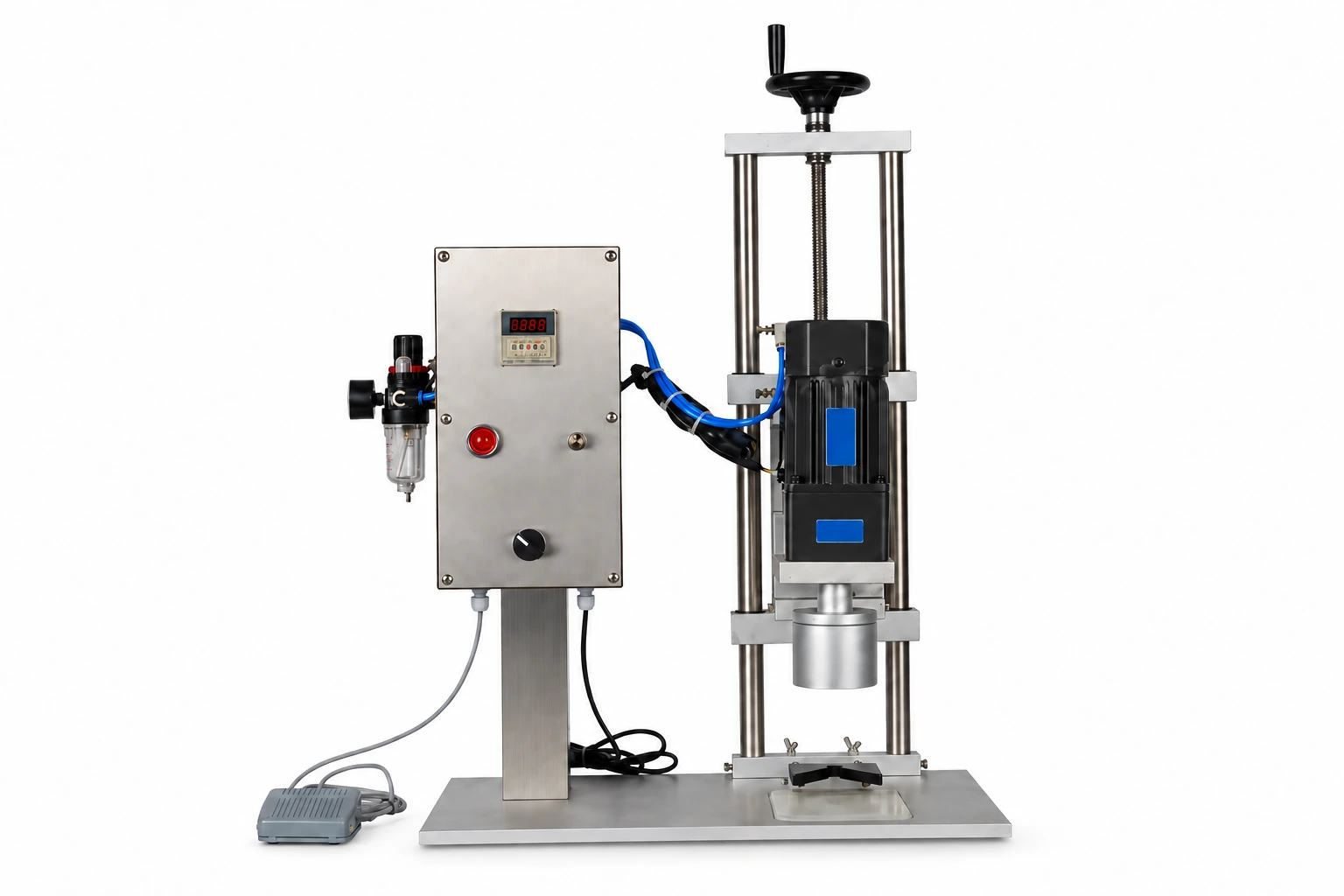
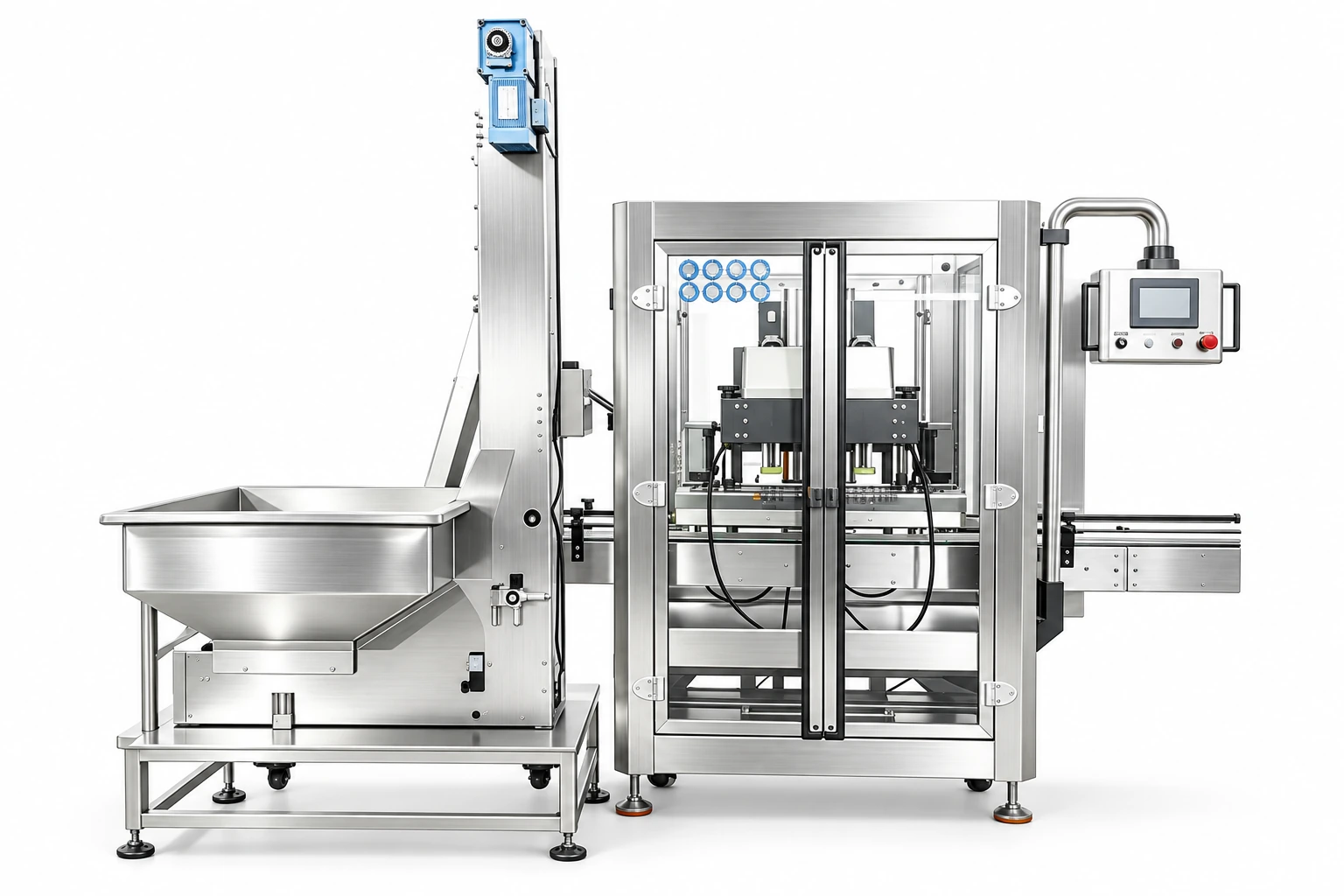
The QDX-450 uses manual bottle and cap placement. The dual-head servo wheel capper works with a conveyor and cap supply system. The difference in daily handling is a useful place to start when comparing them.
QDX-450 semi-automatic screw capper
An operator positions the bottle and cap, then starts the cycle with a foot pedal. Pneumatic vertical motion works with motor-driven tightening for compatible flat-topped plastic screw caps.
Dual-head servo wheel capper
A dual-head servo wheel-capping structure with an elevating cap supply arrangement and guarded working area, intended for compatible threaded closures on a conveyor line.
What to send with your inquiry
Start with photos of the bottle and cap, your batch size, and a brief description of how you work now. The following details help narrow down the equipment and configuration.
- Bottles and caps
Share clear photographs, materials, bottle dimensions, cap diameter and height, and the range of formats you use.
- Closing and inspection requirements
Describe the closing operation, acceptable cap appearance, and any established tightening or opening requirements.
- Output and usable time
Provide your batch target, net working time, shift pattern and expected changeover frequency.
- Current process
Explain manual tasks, existing filling and labeling equipment, and whether conveyor integration is required.
- Site and utilities
Describe available space, electrical supply and compressed air. For a line, include conveyor height and direction.
Common questions about choosing a capper
Why is a motor-driven capper still called semi-automatic?
The description concerns the operating sequence. If an operator still loads bottles, positions caps and removes finished bottles, those manual steps remain part of the workstation’s production pace.
Can I change caps by adjusting the machine height?
Height is only one consideration. Cap diameter, top profile, contact method, bottle support and cap handling may also change. Review the old and new packaging together before a changeover.
Is automatic capping always a good fit for small, varied batches?
Assess format changes, the adjustments required, run length and staffing. Include preparation and changeover time when comparing the two approaches.
Can a filler and capper be connected if their stated speeds match?
Speed is only part of the assessment. Bottle format, conveyor height and direction, spacing, buffering and operating coordination also need to be checked.