
On this page
For filled heat-sealable bags, start by comparing an impulse sealer with a continuous band sealer. Then check the actual pouch construction, filled weight and how the operator presents the bag. These details are more useful than choosing on heater power alone.
Watch the bag sealing process
Follow the bag mouth as it is fed into the sealing path and the filled pack moves along the conveyor.
Which sealing machine fits your task?
“Sealing machine” covers several different jobs. This guide focuses on closing flexible bags and pouches after filling. Bottle-cap liners, cartons and shrink-wrapped packs need different equipment.
| Type | How it works | Selection focus |
|---|---|---|
| Impulse sealer | Closes a bag between sealing jaws for a timed heating and cooling cycle. | Compare jaw length, bag material and the complete load–seal–unload cycle. |
| Continuous band sealer | Carries the bag mouth through a continuous sealing path while a conveyor supports the pack. | Check bag orientation, support, sealing settings and a steady feed of filled bags. |
| Vacuum packaging system | Includes an air-removal process before the final seal. | Specify the package objective and confirm the air-removal method; ordinary heat sealing alone does not provide this function. |
An impulse station can be a practical starting point for intermittent batches. Consider a band sealer when repeated bag handling is the bottleneck and you can supply filled bags consistently. Compare both with your actual batch, including setup and inspection.
Check the bag before the machine
Send an unused pouch and a filled sample. Describe the material layers, total thickness, width, filled height and weight. A paper-looking or foil-looking exterior does not identify the inner sealing layer.
Include the location of gussets, zippers and the intended top seal. The bag mouth must enter the sealing path cleanly and without product trapped in it. Ask the pouch supplier for its sealing recommendations, then verify the combination on the proposed machine.
Choose the handling position
Upright or lying down?
Consider whether the filled pack can lie down without spilling or moving product into the seal area. If it needs to remain upright, check the distance between the conveyor and sealing head against every filled-bag height.
Support the whole pack
Check conveyor width, loading limits and bag stability at entry and discharge. A heavy or uneven pack needs appropriate support throughout the process; a bag that fits beneath the head may still be awkward to feed.
Compare finished bags per shift
Conveyor speed in meters per minute is not the same as bags per minute. Pack spacing, the operator’s feed rate, seal requirements and interruptions all affect completed output.
For planning, 900 bags in three net production hours requires an average of five accepted bags per minute. This is a production target, not a rating for any machine. Ask for a trial at your required pace and count good packs, rejected packs and stops.
Record the time needed for warm-up, bag-size changes, coding changes and cleaning. An attractive short demonstration may leave out the tasks that matter over a full shift.
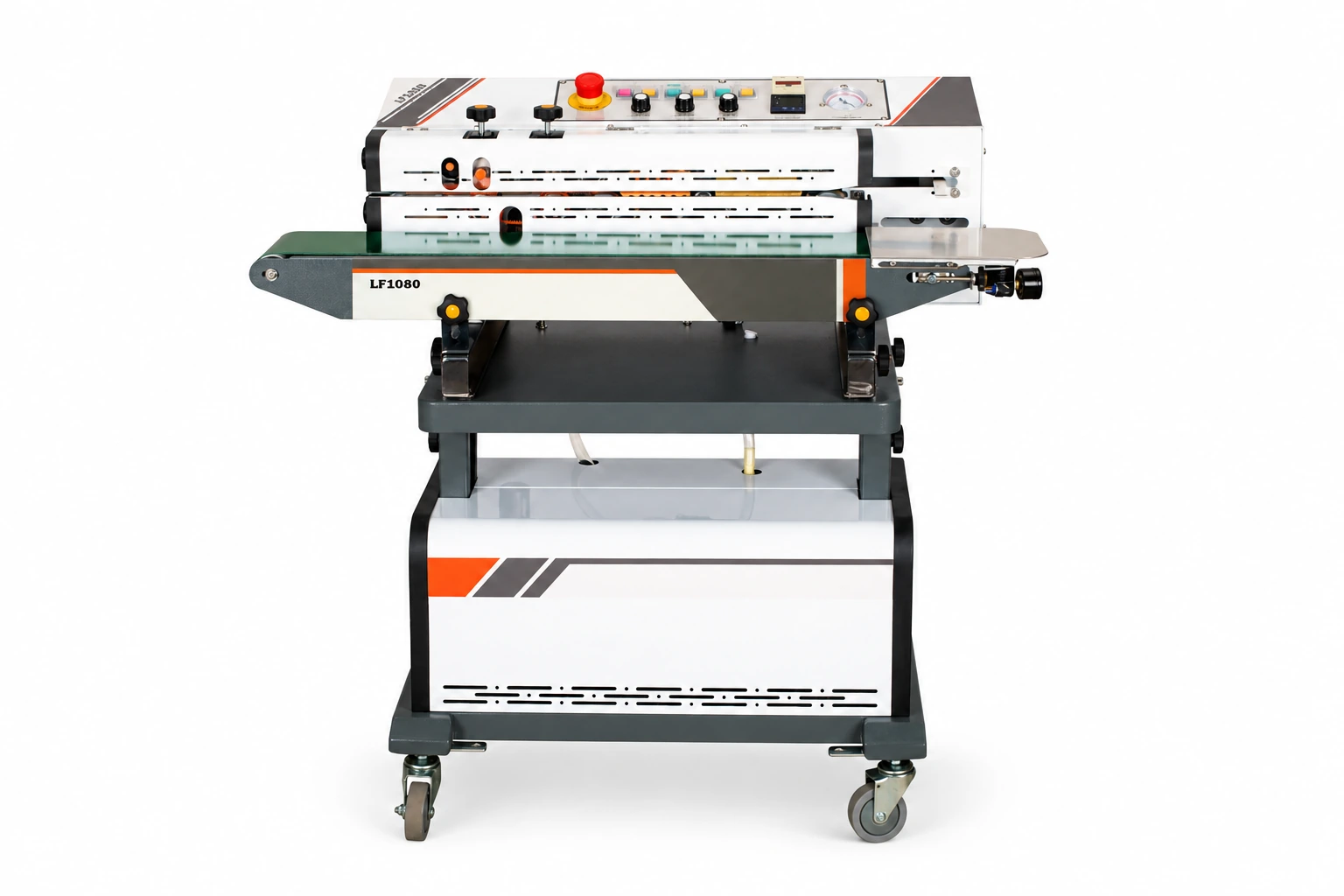
Explore the LF1080 series
The LF1080 series combines conveyor-supported band sealing with solid-ink coding. Its available variants include LF1080A with air suction and LF1080B with air suction plus gas flushing. Select the variant around your process rather than treating these functions as interchangeable.
For gas flushing or air removal, define the required result and how it will be measured with the actual product and pouch. The presence of a nozzle does not establish a particular residual oxygen level or shelf life.
What should a sealing trial show?
- Your production materials
Use the intended bag, normal fill weight and actual product. Include the most demanding format.
- The complete sealing run
Record settings, feed behavior and finished-pack checks across a consecutive run, including restart behavior.
- Acceptance criteria
Agree on seal appearance, the appropriate strength or leak checks, code legibility and the target rate of accepted packs.
- Routine work
Review cleaning access, wear parts, changeovers and operator tasks before comparing the final scope.
Common questions
Can a band sealer seal any plastic bag?
No. The pouch needs a compatible heat-sealable layer and must suit the machine’s operating limits. Test the exact material and thickness rather than relying on the word “plastic.”
Is the highest sealing temperature the best setting?
No. Select settings around the bag construction and the time it spends in the sealing path. A maximum temperature rating is not a recommended setting for your pouch.
Can I use one machine for different bag sizes?
Possibly, but compare the full range of widths, filled heights and weights. Ask which adjustments or parts are needed and include the size change in the trial.
Is a suction band sealer the same as a chamber vacuum machine?
No. The air-removal arrangements differ. Specify the desired finished package and evaluate the suitable process with samples.
Prepare your inquiry
- Product and filled weight
- Pouch material, thickness and dimensions
- Bag photos and samples
- Batch quantity and net operating time
- Coding, air-removal or gas-flushing needs
- Power supply, space and contact details