On this page
Choose a bottle labeler by looking at the container and the label together. A round bottle might need a small panel label or a full wrap. A square bottle might need two separate labels or one label extending across three faces. These are different application tasks.
Begin with a photo or drawing of the required finished pack. Add the actual bottle and label roll. This makes it possible to discuss the application mechanism, rather than relying on broad terms such as round bottle or flat bottle labeler.
For cylindrical bottles, examine how the bottle rotates and how the label is pressed onto it, including any starting-position or seam requirement.
For front-and-back labeling, examine bottle orientation and the required position of each label.
For one label crossing several faces, check the corners and application path separately from a conventional two-label arrangement.
Look beyond the front view of the bottle
Cylindrical and tapered bodies
A bottle that looks round may have different diameters at the top and bottom of the labeling area. Check for taper, shoulders, recesses and other changes in the surface. Trial the bottle and label shape together, watching for skew, wrinkles and lifted edges.
Flat panels and rounded corners
Provide the usable panel width and height as well as corner details. A label crossing an edge must conform to that path. For flexible bottles, observe whether positioning and label pressure deform the body. Overall container dimensions alone do not describe the labeling surface.
Registration to a bottle feature
If a label must line up with a molded seam, embossed design or fixed orientation, show that relationship in a drawing. A standard wraparound action does not establish that the machine can detect and register to a particular bottle feature.
Match the equipment to the label layout
| Application | What to check | What to provide |
|---|---|---|
| Round bottle panel or wrap | Bottle support and rotation; label start, gap or overlap. | Bottle diameter, labeling height and label dimensions. |
| Front and back on a flat bottle | Bottle orientation and the application of each label. | Both label designs and their relative positions. |
| One label across three faces | Corner transitions and adhesion across the faces. | A dimensioned label layout, corner details and a finished-pack example. |
| Top or closure-area label | Application direction and any surface transitions. | The exact location; do not assume a side labeler covers this task. |
Whether one machine can cover several tasks depends on its applicators, guides and tooling. List each bottle-and-label combination. Ask which changes require adjustment, replacement parts or an additional device.
The label roll is part of the specification
Include the label material, width, length, gap and winding direction, plus the core and outside diameter of existing rolls. Identify transparent labels or unusual liners so the detection arrangement can be assessed with the actual material.
Use production bottles and labels for a trial. State whether bottles reach the labeler empty or filled, and describe the expected surface condition, including moisture or product residue. The trial should represent the conditions at the labeling station.
Inspect several consecutive packs for label height, skew, bubbles, wrinkles and edge adhesion. If registration or seam position matters, agree on the permitted variation and checking method before the trial.
Compare a full batch, including changeovers
A semi-automatic station generally involves manual loading, starting and removal. Assess whether the operator can sustain the required batch pace and how bottle diameter or label changes affect the setup.
A conveyor-fed arrangement also needs suitable spacing, guides, positioning and discharge. When connecting it to filling and capping, check conveyor height, travel direction and operating pace. For frequent format changes, ask to see adjustment, parts replacement, label threading and position checks.
Confirm whether the quote includes the positioning devices, tooling, coding and other operations you need. The term automatic labeling machine does not, by itself, define that scope.
Two arrangements for different applications
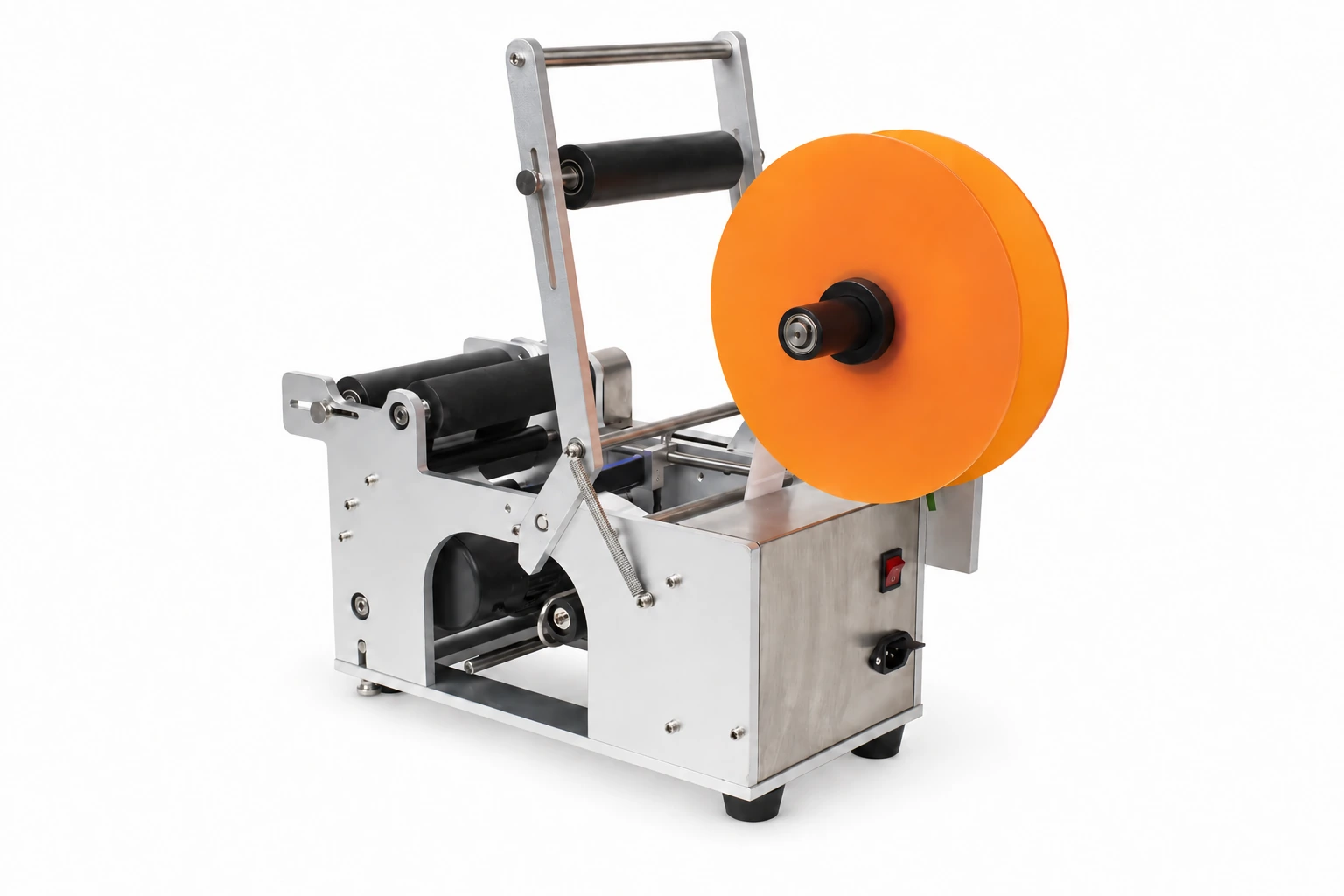
MT-50 semi-automatic round bottle labeler
A tabletop roller-support arrangement for cylindrical bottles and jars, using roll-fed self-adhesive labels. Containers are loaded and removed manually. Check the bottle, usable labeling area and label dimensions together.
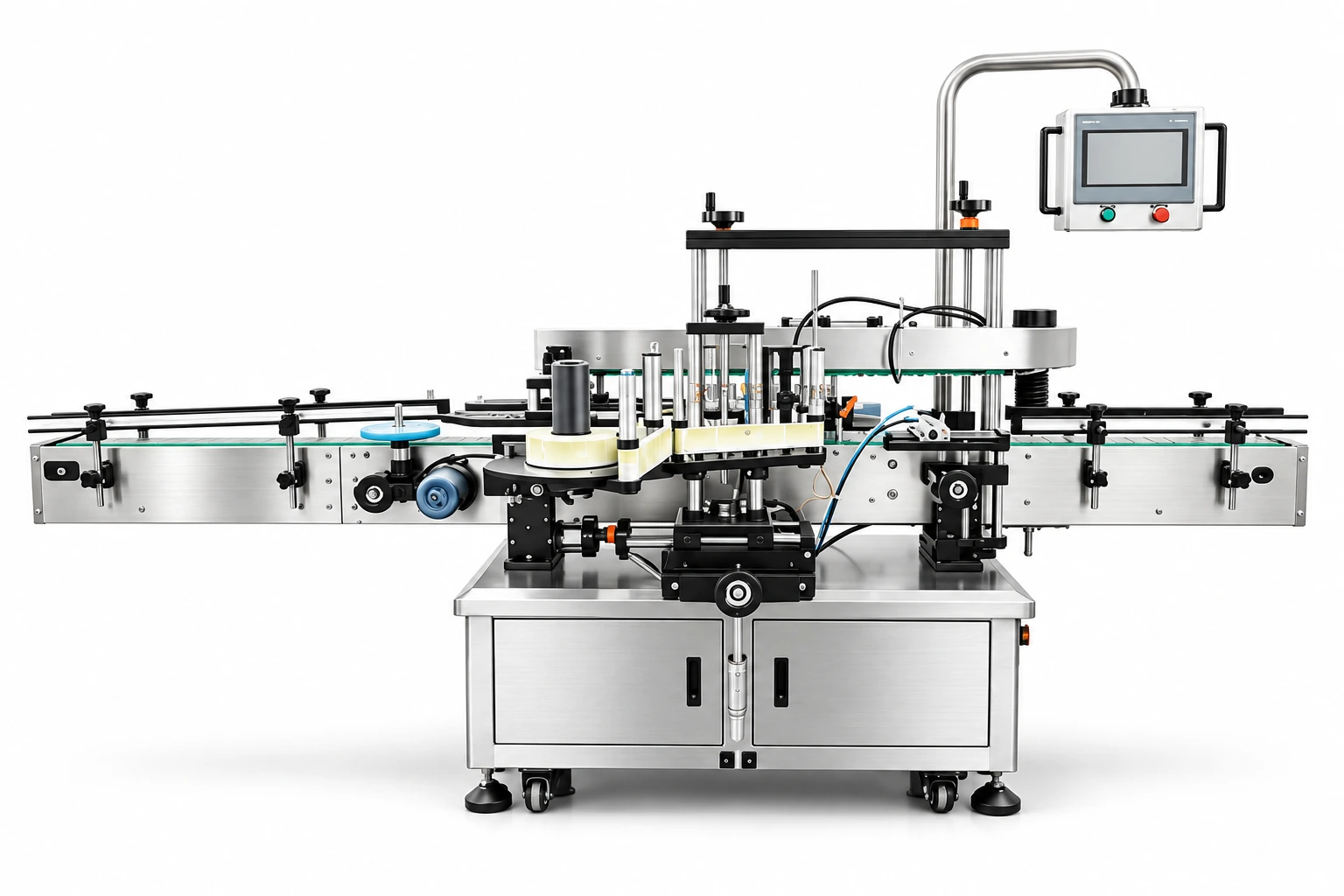
Three-side square bottle labeler
A conveyor and bottle-guiding arrangement for applying a label across three faces of a compatible square bottle. Assess coverage, corner geometry and adhesion after each transition.
These examples serve different applications. If you need conveyor-fed round bottle labeling or two separate labels on a flat bottle, assess those configurations against their own bottle-and-label requirements.
Send the bottle and label details together
- Container and surface
Front and side photos, dimensions, taper, corners, recesses and whether the body is flexible.
- Label and finished appearance
Artwork, material, dimensions, roll direction and the intended position, seam or registration requirement.
- Batches and formats
Quantity per batch, net operating time, number of formats and changeover frequency.
- Related operations
Manual handling or conveyor integration, plus any filling, capping or coding requirements.
Bottle labeling: common questions
Can a round bottle labeler also label square bottles?
That depends on the configuration. The support, rotation and application used for round bottles cannot simply be assumed to suit square ones. Provide every intended format and assess each separately.
Is three-side labeling the same as front-and-back labeling?
No. Two separate labels on opposite panels and one label crossing three faces require different feeding and application paths. Include a flat label layout with your inquiry.
Can I use transparent labels?
Check the sensing arrangement, liner and complete roll material with actual samples. A photo of the label face does not establish all compatibility conditions.
Can one machine handle several bottle formats?
Some arrangements support changeovers. Check dimensions, label positions, guides and tooling for each format, including the parts and adjustments required to thread and position the next label.