
In this guide
A 250 ml bottle of liquid soap and a 250 ml jar of thick cream may need very different filling setups. Consistent feeding, a clean cut-off at the opening and a practical cleaning routine all matter in daily production.
For a flowable paste with containers positioned by hand, a hopper-fed semi-automatic paste filler is a useful starting point. Share the actual product behavior, filling temperature, dose and container opening before selecting a metering range and outlet arrangement.
Start with product behavior
Cream, shampoo and sauce are product categories, not complete filling specifications. Formulation, temperature and particles can change how each product feeds and dispenses. These three groups provide a starting point for a selection discussion.
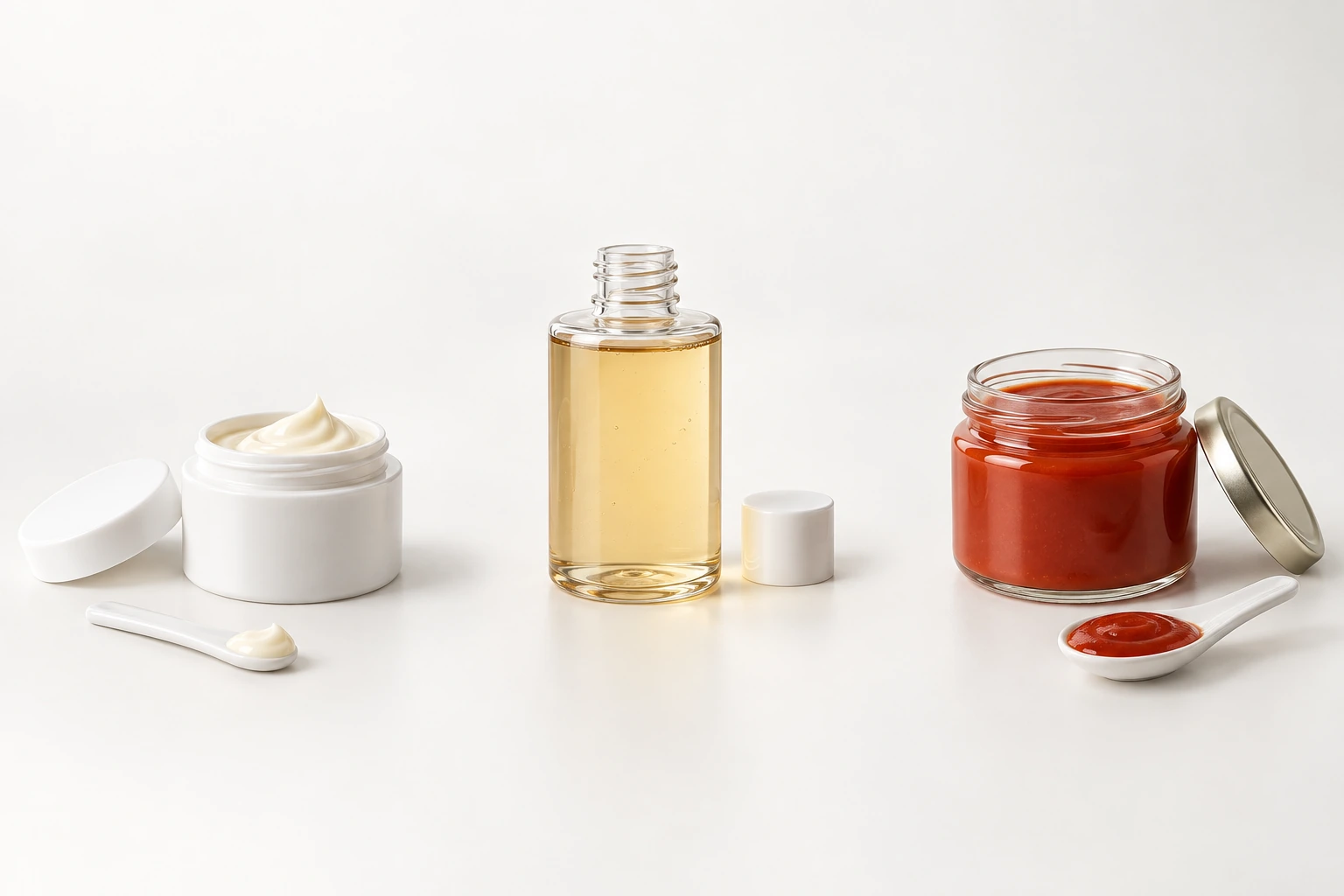
Creams & flowable pastes
Check flow at the intended filling temperature. Look at consistent feeding, stringing after dispensing and residue around the jar opening.
Personal-care liquids
Describe foaming, stringing and the neck opening. Pump bottles are normally filled before fitting the pump; provide the open-bottle dimensions and required headspace.
Smooth sauces
Identify seeds, pulp, fibers or other particles, plus the filling temperature and cleaning requirements. A smooth sample cannot establish suitability for a chunky recipe.
Three machine details to check
The G1WG single-head paste filler uses a hopper-fed pneumatic metering arrangement with foot control. An operator positions the container under the outlet and triggers filling. Dosing and dispensing are handled by the equipment; container handling remains manual.
Hopper & feeding
Check that the product can feed consistently. Heating, agitation or special feed arrangements require a separate configuration review.
Nozzle & valve connection
Check container alignment and residue, drips or stringing after cut-off.
Foot control & handling
Foot control triggers filling. The operator still positions and removes containers, checks results and manages replenishment.
Illustrations show comparable arrangements. Details depend on the selected equipment configuration.
Prepare
Follow the operating instructions for cleaning, feeding and air supply. Confirm the selected metering configuration.
Position & fill
Align the bottle or jar opening with the outlet and use the foot control to trigger the fill.
Remove & check
Check the dose and neck cleanliness, remove the container and prepare the next one.
If containers need to enter, position and move on to capping or labeling automatically, compare conveyor-fed filling arrangements and line interfaces. A single-head manual handling station does not provide those handling steps by itself.
Choose a dosing range around your usual packs
List the fill quantities you use most, then check every planned size. The G1WG ranges below represent different metering configurations. They do not describe one machine continuously covering 10 ml through 5,000 ml.
If you regularly fill 50 ml and 250 ml, submit both quantities rather than only the larger one. Check repeatability at the smaller dose and at your main production dose, and identify the adjustments or parts involved in changing formats.
The opening matters as much as the volume
A wide-mouth jar and a narrow-neck bottle need separate checks for outlet dimensions, positioning and working clearance. Send the internal opening diameter, height and body dimensions, with photos of the empty container and closure.
Grams and milliliters are different requirements
For a net-weight target, specify the required mass and tolerance. Use product density and filled-container weighing to verify the setup. Do not assume that 250 g equals 250 ml.
Read the specifications in context
These G1WG figures are a selection reference. Confirm the electrical version, dosing configuration and utilities in the order. Assess the working pace with the actual product, dose and manual handling time.
| Operation | Single head, hopper feed, foot control; manual container handling |
|---|---|
| Reference filling speed | 5–25 bottles/min |
| Air pressure | 0.4–0.6 MPa |
| Electrical version | AC 220 / 110 V, 50 / 60 Hz; specify when ordering |
| Rated power | 20 W |
| Metering configuration | Select for the required dose; see the six ranges above |
The speed range is a reference, not a fixed rate for every product or dose. Pressure alone is not enough to size a compressor: check air consumption, air treatment and other equipment drawing from the same supply.
Turn a batch target into a working pace
For example, 1,200 bottles in 120 minutes of net operating time requires:
1,200 ÷ 120 = 10 bottles/min
That allows an average of six seconds per bottle for handling, filling and necessary checks. Budget additional time for replenishment, cleaning and changeovers. This is a demand calculation, not measured machine output.
Include the next operation. Who places the caps, tightens them and applies the labels? If one operator performs those tasks too, the complete workflow will not run at the dispensing-only rate.
What to check during a sample trial
Use the intended production product and containers. Record the temperature, metering configuration and machine settings so that the results describe a repeatable setup.
- Consistency across consecutive fills
Record consecutive results with one measurement method and compare them with the agreed target and tolerance. Subtract the empty-container weight when checking by mass.
- Cut-off and container cleanliness
Look for hanging product, strings, drips, foam and residue at the opening. Use the same acceptance criteria before and after adjustments.
- Different doses and openings
Include the main production dose, smaller planned doses and unusual openings. Record the adjustments and working clearance needed for each format.
- Cleaning and product changeover
Review the contact path, seals, disassembly and cleaning-agent compatibility. Define the cleaning requirements for each recipe or fragrance.
Agree on the product, temperature, container, target quantity and allowed variation. A short video of fast dispensing does not establish all of those conditions.
Paste filling machine questions
Can the G1WG fill creams and sauces?
Flowable creams, pastes and sauce-type products are candidates for assessment. Confirm formulation, particles, temperature, contact materials and cleaning requirements. A product name alone cannot establish suitability for a sauce containing particles.
Why do products with the same fill volume run at different speeds?
Flow behavior, temperature and the outlet arrangement affect the time needed to feed and dispense the product. Manual container handling and inspection also contribute to the completed rate.
Can it run with electricity but no compressed air?
The G1WG uses pneumatic metering and requires a suitable compressed-air supply. Check pressure, consumption and air-treatment requirements along with the electrical version.
Can one configuration handle sample sizes and large packs?
List all doses and check them against the selected metering range. A large difference between sample and bulk packs may require different metering configurations. Do not assume a single adjustment covers every size.
How should filling accuracy be verified?
Agree on the target, tolerance, measurement method and test conditions, then check consecutive fills with the actual product. General figures do not replace acceptance results for your recipe and dose.
Send these details with your inquiry
You do not need to identify the pump or valve type first. Start with your product, containers and production requirements.
- Product
Name, formulation characteristics, working temperature and a flow video. Identify particles, foaming or stringing.
- Doses and containers
Each quantity in ml or g, container photos, internal neck diameter, height and body dimensions.
- Production plan
Batch size, available time, operators, changeover frequency and the planned capping and labeling steps.
- Utilities and cleaning
Power, compressed air, contact-material requirements, cleaning method and available space.